Some simple and not so simple maths problems
These come from different sources. Some come from books and are a few
hundred years old. I learned others from my friends. One is especially
memorable. It was posed (and solved) on a rainy night in Australia,
as we drove west from Sydney, trying to find a hole in the clouds
to see the Leonids meteor shower....
- A cask of kvas.
A man drinks a cask of kvas (ancient Russian soft drink) in 14 days.
Together with his wife they drink a similar cask in 10 days. How many days
does it take the wife to drink it up by herself?
- The twelve people.
Twelve people carry 12 loaves of bread. Each man carries two loaves,
each woman has a half, and each child holds a quarter.
How many men, women and children are there?
- A fake coin.
Among nine coins there is a fake one which is lighter.
How to find it using a balance if only two weighings are allowed?
- Dangerous crossing.
Four creatures A, B, C and D come to a river at
night. The bridge is very thin and narrow, and can only hold any two of them at
a time. Besides, it is dark and they need to keep their torch
on while on the bridge. It takes A one minute to cross the bridge,
B - 2, C - 5, and D - 8 minutes. Can they all cross to
the other side if the batteries in the torch last only 15 minutes?
- The seven bridges.
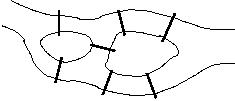
The old city of Konigsberg (now called Kaliningrad)
had two islands and seven bridges.
Its citizens always wanted to know if one could traverse all the bridges
without taking the same bridge twice. What do you think?
- 64-2.
Two diagonally opposite squares have been cut away from a chess board.
Is it possible to pave it with domino pieces? (Each domino piece covers
two adjacent squares on the board.)
- Merchant's problem.
A merchant had a 40 pound weight. Once it fell and broke into four
pieces. The merchant was very sad, but then realised that with the four
new ``weights'' he could weigh any amount with an integer weight between
1 and 40 pounds by his balance. What were the weights of the pieces?
(Remember that when weighing something you can put weights
in both pans.)
- A tricky catch.
Three men on a fishing trip stopped by a river and fished untill darkness.
They put their catch in a bucket, had a quick meal and went to sleep.
When one of the fishermen woke up early next morning the other two were still
asleep. He counted the fish in the bucket, realised that the number could
not be divided by three, threw one fish back into the river, took one
third of what was left, and left quietly. When the second man woke up
he did not notice that the first one was already gone. So he counted the fish,
saw that the number was not divisible by three, threw one fish into the river
and left with his "third". Believe it or not, the same thing happened
to the third fisherman. Upon waking up, he did not notice that the other two
had already left, so he counted the fish, threw one fish into the river,
took one third of the remaining fish and went home. How many fish were
originally in the bucket? (Find the smallest possible number.)
- Ship spotting.
Every day at noon (GMT) an ocean liner of a certain shipping line leaves
Southampton for New York, and another one leaves New York for Southampton.
It takes the ships exactly seven days to complete the journey. How many
liners bound for Southampton can a passenger spot during a sailing to New
York?
- A pizza and a half.
If a student and a half can eat a pizza and a half in an
hour and a half, how many pizzas will 12 students eat in 3 hours?
- The hungry mouse.
A mouse will gain 2 grams of weight every day eating as much cheese as
possible. Not eating results in losing 3 grams of weight per day. If the mouse
gained 5 grams over 20 days, how many days were spent not eating for the
mouse?
- Fixing the chain.
Suppose you have 5 sections of the same type chain, each of which contains
3 links. You want to put them all together to make one length of chain.
It costs £2 pounds to cut a link and £4 to weld a link. What is the
most inexpensive way to make the new 15 link chain?
- Lots of lockers.
A school has a hall with 1,000 lockers numbered 1 to 1000, all of which are
closed. A thousand students start down the hall. The first student opens
every locker. The second student closes all the lockers whose numbers are
multiples of 2. The third student changes (i.e., closes an open locker or
opens a closed one) for all lockers with numebrs that are multiples of 3.
The 4th student changes all multiples of 4, and so on. After all students
have finished with the lockers, how many lockers are open and which ones?
- A pilgrimage.
A monk from a monastery at the foot of a mountain, begins to ascend
it at sunrise. He follows a track, takes rests to catch a breath or to
have a meal, and arrives at the summit at sunset. After spending the night
there, he begins his descent at sunrise and follows the same track downhill,
with occasional stops, to arrive back at the monastery at sunset. Must
there be a spot along the track which the monk visited at the same time on
both days?
- A wolf, a goat and a cabbage.
You need to ferry a wolf, a goat and a cabbage in your care,
to the other side of a river. You have a boat which can only hold you
and one other item (either the wolf, or the goat, or the cabbage).
How can you fulfil your task if the wolf will eat the goat, if left
together unsupervised, and so will do the goat to the cabbage!
- A New York story.
A young man lives in Manhattan near a subway station. He has two girl
friends, one in Brooklyn, one in The Bronx. To visit the girl in Brooklyn
he takes a train on one side of the platform; to visit the girl in
The Bronx he takes a train on the other side of the same platform.
Since he likes both girls equally well, he simply takes the first train
that comes along. The young man reaches the subway platform at a random
moment each Saturday afternoon. Brooklyn and Bronx trains run every 10
minutes. For some reason he finds himself spending most of his time with
the girl in Brooklyn: in fact on the average he goes there nine times out
of ten. Why does this happen?
- Safe keeping.
An international committee consists of 9 people. The committee keeps
important papers in a safe. How many locks must the safe have, and how many
keys for them should be produced, so that it can be opened precisely when
at least 6 members of the committee are present?
- Dropping the ball.
Someone is given two identical balls that can break when dropped from a
certain unknown height. To find what this height is, the person is
allowed to drop them from any floor of a 100-story skyscraper. What should
be the strategy that would allow one to find at what floor the balls break
using the smallest number of drops?
- Hostage drama.
A group of 100 people have been taken hostage. Their captors explained
that they are going to put a white or black hat on the head of each hostage,
in such a way that they would not know its colour. The hostages will then
be formed into a single file, so that each can see all other
hostages in front, but not those behind. Each hostage will then be asked
to call the colour of his or her hat, starting from the back of the file.
Those who get the colour correctly are set free. Those who get it wrong
will be shot.
The hostages will not be allowed to communicate once the hats are put on.
However, they have a few minutes now to work out a strategy that would
allow as many of them as possible to be saved. What should this stragy be
and how many can be guaranteed to be freed?
- Prison drama.
A certain mumber of people are put in a jail. Before they are taken to their
solitary cells, their jailers explain that each day one of them, chosen
randomly, will be
taken into a room that contains a two-position switch, and will be alowed to
change its position if they want to do so. The prisoners are allowed to
nominate one of them as their leader. The leader (who will also be taken to the
switch room, on equal footing with the rest) is allowed to declare at some
point that all prisoners have been to the switch room. If he is right,
the prisoners will be set free. If he is wrong, they will remain in jail
forever.
Before they are separated, the prisoners can discuss the matter and choose
their leader and the strategy that may allow them to go free one day.
What should this be?
Do not rush to use these hints!
Visitor:
This counter is provided by
http://www.digits.com/
Back to homepage
Dr. Gleb Gribakin / phone: +44 (0)28 90273161 / fax: +44 (0)28
90239182
E-mail: g.gribakin@qub.ac.uk